WHY NOT?
7 September 2026

Hello again, fans of science,
Kia ora anō, e ngā kaiwhaiwhai pūtaiao,
[About 210,000 New Zealanders can speak Maori.]
GOOD NEWS

For the first time in 75 years, the population of the flightless New Zealand Kakapo (Maori: parrot of the night) is up to 325 birds thanks to huge conservation efforts and fruiting rimu trees. These 4 kg birds only mate during years when rimu berries are abundant.

The U.S. is currently experiencing “Very Low” incidences of acute respiratory illnesses.

21 minute video of Good News: Africa electrification, Amazon rain forest preservation, Earth’s fungal network, the Green Economy, Przewalski Horse rewilding, rebuilding Australian habitats, Central Arctic Ocean Fisheries Agreement, UNESCO Sites, HPV vaccination success, DNA wildlife survey, wildlife over- & under-pass construction, invasive rat removal, satellite detection of wildfires, & more.

A ‘dark matter’ particle may have been detected. There is far more dark matter in the Universe than ‘regular’ matter, but attempts to detect dark matter have been fruitless – until now. The potential detection was found after reëxamining data from over 200 days of observations carried out with the LUX-ZEPLIN experiment 1.5 km underground in South Dakota. The event had been overlooked previously since the team was looking for a less energetic event. They are now reëxamining another 400+ days of data looking for a similarly energetic interaction. Video – 13 mins

The BepiColombo probes are now approaching Mercury at the planned velocity and have jettisoned their ion thruster module. The BepiColumbo mission consists of two conjoined space probes: the European Space Agency (ESA) Mercury Planetary Orbiter (MPO) and the Japan Aerospace Exploration Agency (JAXA) Mercury Magnetospheric Orbiter (Mio). The mission launched eight years ago from French Guiana. It would have whizzed past Mercury at 37 km/sec had it not used gravity assists to slow down. It used the Earth once, Venus twice, and Mercury six times to scrub off speed. In December, Mio will detach from MPO and they will each go their own ways collecting data.

Vaccination rates in California exceed the National average across the board.


A “Correct the Map” resolution was introduced in the United Nations on Friday by Togo on behalf of the 54-nation African Group and subsequently passed. [The only “No” vote came from U.S. Representative Yaryna Ferencevych who stated that the resolution promoted an “ideological agenda.”] The resolution encourages the use of Equal Earth Projection maps. The Mercator Projection (by Gerardus Mercator in 1569) was a boon for early ocean navigation since a straight line between any two locations gave the compass heading needed to get there [after correcting for magnetic declinations]. As a ‘geographical map’, however, the Mercator Projection exaggerates areas closer to the poles (as shown by the animation above). Also, great circle routes are shorter than Mercator’s constant heading routes. Computers and GPS now make the Mercator Projection pointless. The Equal Earth Projection above indeed shows correct proportions of lands and seas, and it can be created to center on any line of longitude.
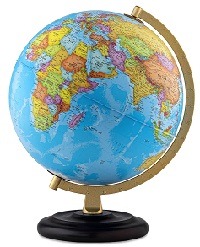
Best of course is a world globe, unless you need it on page 42 of your report.
The Ig Nobel Prize for Physics was awarded to Randy Hurd, Zhao Pan, Tadd Truscott, and Kaveeshan Thurairajah of the King Abdullah University of Science and Technology in Saudi Arabia for designing a splash-free urinal.

ONGOING EDUCATION
Aliens in Science and Science Fiction: Where Do We Stand in our Search for Intelligent Life Out There?
Wednesdays from 3 to 5 pm (Sep. 30 – Nov. 4, 2026)
Either via Zoom or in Person in the Humanities Building at San Francisco State College
Space is Limited: Register Early
Three easy steps to register:
- Sign in or create a free account at: https://www.campusce.net/sfsu/account/signin.aspx
- Register for the in-person class at: https://www.campusce.net/sfsu/course/course.aspx?C=1379&pc=138&mc=0&sc=0 or for the Zoom class at: https://www.campusce.net/sfsu/course/course.aspx?C=1380&pc=138&mc=0&sc=0
- If you do not yet have an Annual Membership (a modest fee) you will need to add one to your cart when you select the class. The Annual Membership is one of the choices in the catalog at the bottom, or at this link: https://www.campusce.net/sfsu/course/course.aspx?catId=14
Andrew Fraknoi retired as Chair of the Astronomy Department at Foothill College in 2017. He was chosen the California Professor of the Year in 2007 by the Carnegie Endowment and has won several national prizes for his teaching. He is the lead author of OpenStax Astronomy, a free, electronic textbook, which is now the number one astronomy textbook in North America. Recently, he has been writing science fiction stories with good astronomy in them; 13 of his tales have been published so far, many of them about getting in touch with aliens. He appears regularly on local & national radio, explaining astronomical ideas in terms everyone can understand. The International Astronomical Union has named Asteroid 4859 Asteroid Fraknoi to recognize his contributions to the public appreciation of science. See: http://fraknoi.com for more information about his work.
The Osher Lifelong Learning Institute at San Francisco State is a community of inquiring adults, age 50+, offering non-credit courses, lectures, and interest groups. Many are held remotely, so you don’t need to reside in San Francisco to participate. You must become a member of the Institute to take the class, but the cost is quite reasonable.
GOOD NERDY VIDEOS
30-Passenger Electric Airplane’s 1st Flight – Heart Aerospace – 2.5 mins
Only a test bed? Too bad!
Probing Dark Energy with Nancy Roman Space Telescope – NASA Goddard – 4 mins
¿Probing or disproving?
Relativity Effect Confirmed 110 Years Later – Sabine Hossenfelder – 6 mins
Twisted!
Super-Tall Wind Turbines & End of Coal – EuroNews – 8 mins
I’m acrophobic
¿Where Did the Moon Come From? – SciShow – Savannah Geary – 12 mins
Could have been VERY chaotic!
‘Octopus’, ‘Kraken’, & Clean Energy – Just Have a Think – David Borlace – 16 mins
[Not sea monsters]
¿Is Dark Energy Real? – Dr. Becky – Becky Smethurst – 17 mins
¿Or is our Cosmic Yardstick faulty?
Thwaites Glacier Research 2026 – PBS – Miles O’Brien – 27 mins
Some success; some failure
Predator & Prey: 10 Vignettes – BBC Earth – David Attenborough – 28 mins
Beautiful, creepy, fascinating!
Phosphorus – Tales from the Periodic Table – Ron Hipschman – 36 mins
The “Devil’s Element”
¿Will AI Make Grad Students Obsolete? – Matt O’Dowd, Tyson, & Rice – 56 mins
Love this!
Have a fun week [while strengthening your compassion & empathy muscles],
Dave Almandsmith
“La science, mon garçon, est faite d’erreurs, mais d’erreurs qu’il est bon de commettre, car elles mènent peu à peu à la vérité.”
“Science, my lad, is made up of errors, but errors that are good to make, because they lead little by little to the truth.”
Jules Verne (1828 – 1905) French novelist, poet, and playwright